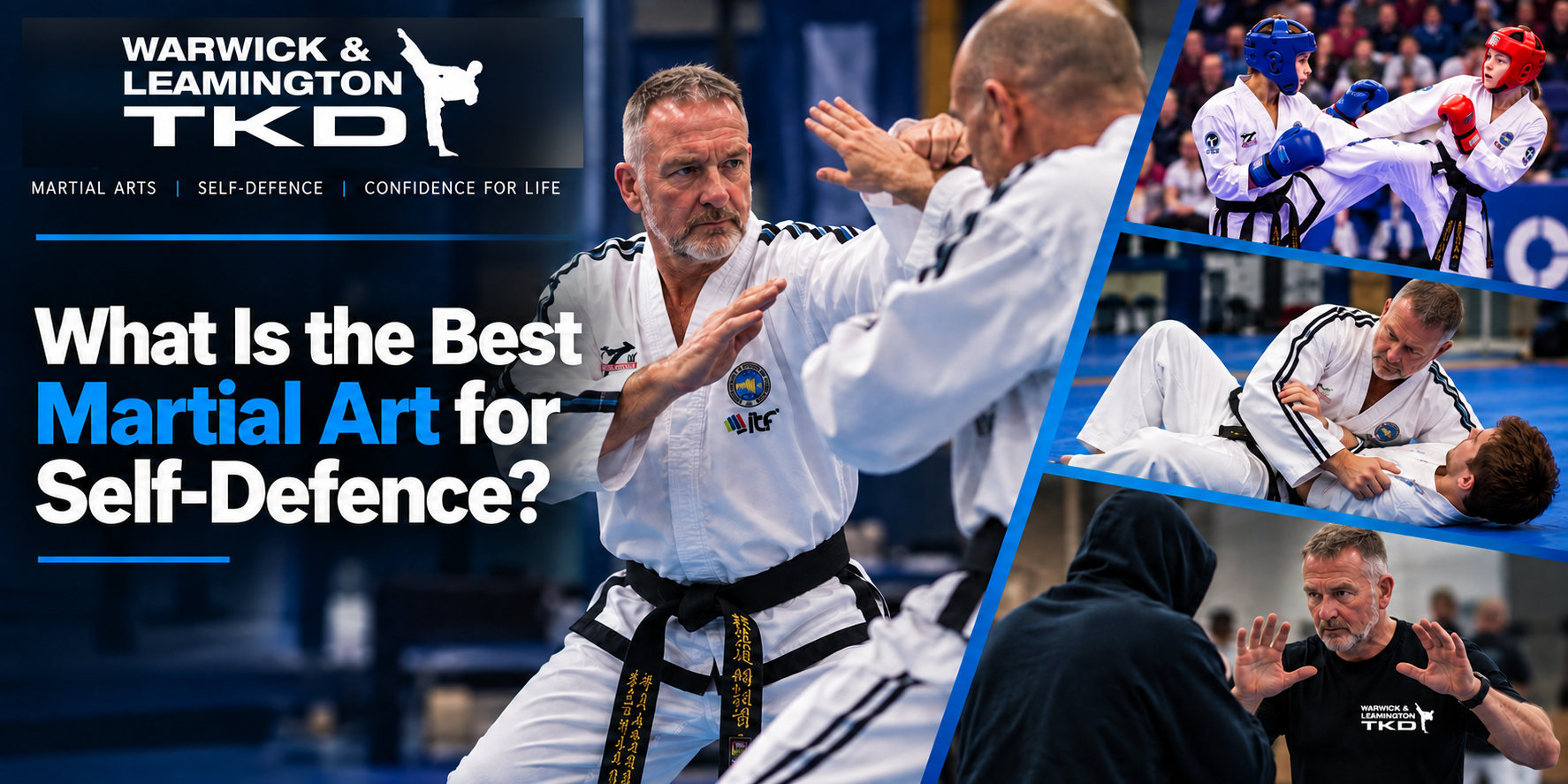
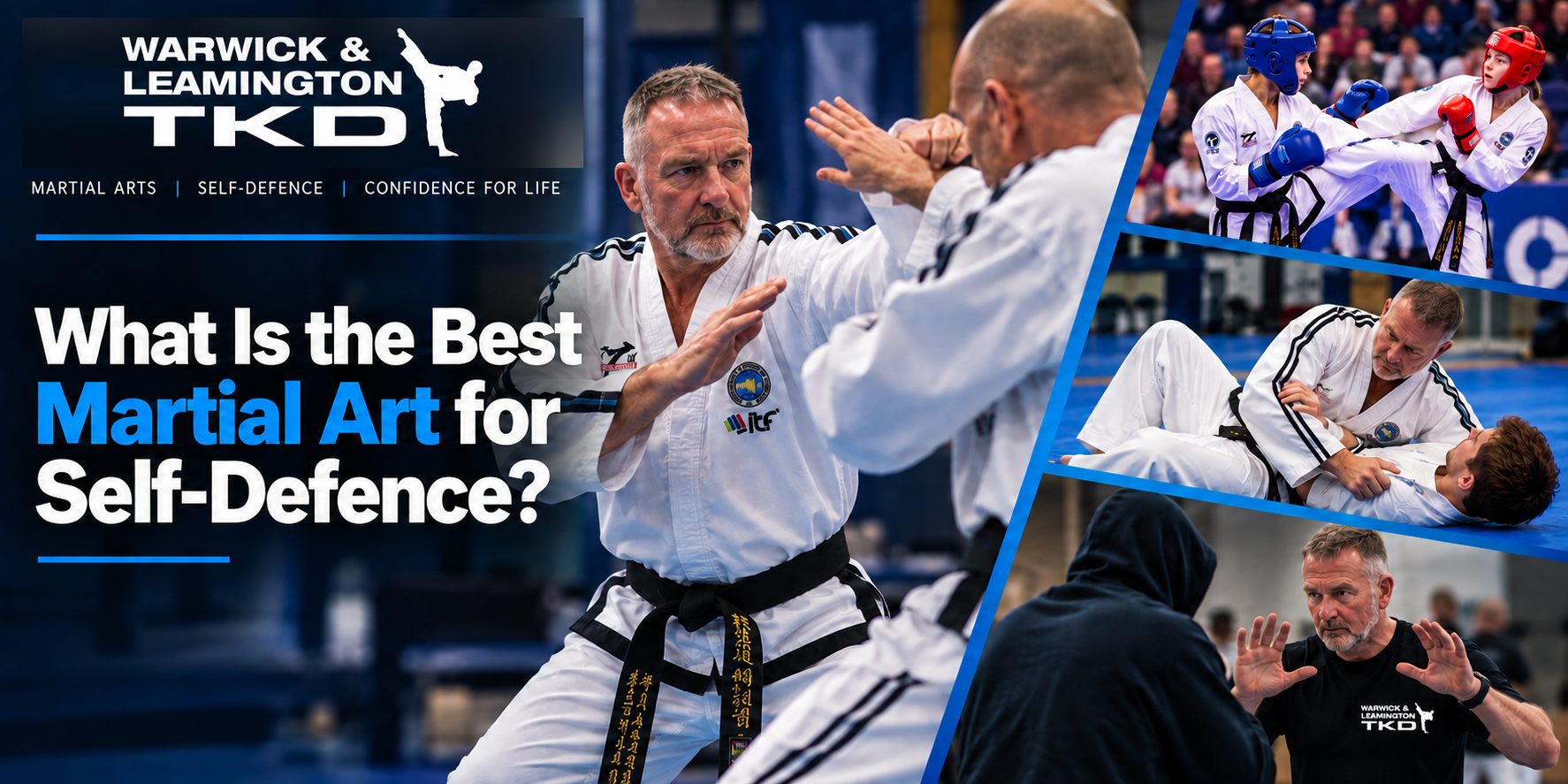
Choosing the best martial art for self-defence isn't simply about choosing Taekwon-Do, Karate,BJJ or another style. The instructor's experience, how you train and whether the training reflects the realities of personal protection can matter just as much. Warwick & Leamington TKD Chief Instructor Martin Noddings explains what prospective students should look for when choosing martial arts and self-defence training.
If you're thinking about starting a martial art, you'll probably discover something very quickly.
Everyone appears to claim that their martial art is the best.
Search for martial arts or self-defence classes in Warwick, Leamington Spa or Warwickshire and you'll find Taekwon-Do, Brazilian Jiu-Jitsu (BJJ), Karate, Judo, Kickboxing, MMA and numerous other systems.
So how do you decide?
Is there actually a "best martial art for self-defence"? Is Taekwon-Do effective in a real confrontation? Is BJJ better because it teaches ground fighting? Should you choose a traditional martial art, a combat sport or a dedicated self-defence system?
And perhaps most importantly:
How much attention should you pay to the experience of the person actually teaching you?
At Warwick & Leamington TKD, we believe these are questions prospective students should ask.
Choosing a martial arts club shouldn't simply be about finding the nearest class, the cheapest membership or deciding which martial art looks most impressive on social media.
If one of your reasons for training is learning to protect yourself or somebody you care about, you need to understand what you're being taught, why you're being taught it and what experience sits behind the instruction.
What is the best martial art for self-defence?
There isn't a simple answer, because the instructor and the way you train can matter just as much as the name of the martial art above the door.
A good self-defence programme should develop more than the ability to punch, kick, throw or grapple. Effective personal protection begins much earlier.
It should teach awareness, threat recognition, distance and positioning, avoidance, conflict management and, where possible, de-escalation.
Physical intervention should be the last resort, not the starting point.
If physical force does become necessary, the objective in genuine self-defence is also very different from the objective in sport. There is no medal, there are no points, there is no referee!!
The objective is to protect yourself, create an opportunity to disengage and get to safety.
That distinction is fundamental to the way we approach self-defence at Warwick & Leamington TKD.
What's the difference between martial arts, combat sports and self-defence?
The three overlap considerably, but they aren't the same thing.
A traditional martial art can develop technical ability, discipline, fitness, coordination, confidence and resilience.
A combat sport tests physical skills against a resisting opponent within an agreed ruleset.
Self-defence is concerned with protecting yourself or somebody else in an uncontrolled situation.
Competition has rules for good reason. There are defined competition areas, referees, prohibited techniques and often weight divisions. Crucially, both competitors know a contest is about to take place.
A genuine assault will provide none of those safeguards.
You may not know the ability or intentions of the aggressor. You may not know whether they have a weapon or whether somebody else is about to become involved. Even the environment around you can become a hazard.
That doesn't make competition training irrelevant. Quite the opposite.
Competition develops timing, distance, movement, composure and the ability to perform under pressure against somebody actively trying to stop you.
Warwick & Leamington TKD has a long history of success in competition at regional, national and international level. At the 2026 ITF England National Championships alone, our competitors returned with 31 medals, including seven gold and 13 silver medals. We value competition and encourage those who want to compete.
But we don't confuse competition with self-defence.
Is Brazilian Jiu-Jitsu good for self-defence?
Brazilian Jiu-Jitsu is an extremely effective grappling art and combat sport.
Good BJJ practitioners develop excellent positional awareness, leverage, control and the ability to operate while another person is physically resisting them. If you're grabbed, taken down or find yourself on the floor, grappling knowledge can undoubtedly be valuable.
The sensible argument isn't that BJJ has nothing to offer self-defence. It clearly does. The more important question is:
Is a strategy primarily based around controlling and submitting one opponent on the ground the strategy you would choose in an unpredictable real-world confrontation?
For personal protection, our answer is no.
On a mat, going to the ground is an integral part of the sport. Outside the training environment, the ground could be concrete, tarmac, broken glass, furniture or stairs.
More importantly, you may not know whether the person confronting you is alone.
If you're committed to controlling one person on the floor, your mobility and ability to escape can be severely compromised if another person becomes involved. A weapon changes the situation again.
Our philosophy is therefore straightforward:
Stay mobile and remain on your feet where possible.
However, "don't go to the ground" does not mean "don't learn ground skills".
You don't always get to choose. You can fall, slip, be tackled or be knocked down. That's why ground defence forms an important part of our self-defence training at WLTKD.
The emphasis, however, is on the skills most relevant to personal protection. Students learn how to protect themselves, manage an immediate threat, create space and regain their feet as quickly and safely as circumstances allow.
We aren't training to remain on the ground and out-grapple somebody for longer than necessary. We are training for the possibility that we may find ourselves there and need effective skills to survive the situation, disengage and get back to our feet.
The difference is the objective. In sport grappling, remaining engaged and achieving control or submission may win the contest.
In personal protection, getting off the ground and escaping may be the victory.
Is Taekwon-Do effective for real-world self-defence?
It certainly can be — when it is taught with real-world application in mind.
ITF Taekwon-Do provides an extensive striking system and develops speed, power, balance, movement, distance, timing, coordination and physical conditioning.
But simply learning techniques doesn't automatically make somebody effective at self-defence. Training needs to connect those physical skills with the realities of confrontation.
At WLTKD, that means going beyond patterns, line work and competition sparring. Students learn practical applications, effective striking, releases, range and movement, and how techniques may need to adapt when circumstances change.
More importantly, those physical skills sit within a wider understanding of personal safety.
Why is situational awareness so important?
Because one of the most effective self-defence techniques is recognising a problem early enough to avoid it.
People sometimes imagine self-defence beginning when somebody throws a punch.
Professional personal protection doesn't work that way, and neither should good self-defence training.
Who is around you? What are they doing? Is someone's behaviour changing? Are you allowing somebody to move unnecessarily close? Where are your exits? Is an argument escalating? Has the atmosphere around you changed? (Known as the concentric rings of disturbance).
These aren't spectacular martial arts techniques. But they may prevent you ever needing one.
At WLTKD we place considerable emphasis on situational and environmental awareness, recognising changes in behaviour and surroundings, positioning, conflict management, de-escalation and appropriate decision-making.
Physical techniques become necessary when those earlier options aren't available or haven't worked.
Why does your martial arts instructor's experience matter?
This may be one of the most important questions a prospective student can ask:
Who is actually teaching me — and what qualifies them to teach real-world self-defence?
A black belt demonstrates achievement within a martial art.
It doesn't automatically demonstrate expertise in violence, threat assessment or personal protection.
Likewise, somebody can be an excellent competition coach without professional experience of dealing with threats outside a sporting environment.
That isn't a criticism. They're simply different areas of expertise.
But if an instructor is teaching something as "real-world self-defence", it is reasonable to ask what informs their understanding of the real world.
At Warwick & Leamington TKD, Chief Instructor Martin Noddings brings an unusual combination of experience to the club.
Martin is a 7th Degree Master Black Belt with more than 45 years' martial arts experience. He is a former England Taekwon-Do Team Captain, represented Great Britain internationally, became European Champion and has won eight British titles.
His experience, however, has never been limited to one martial art. Over the years his wider training has included Shotokan Karate, full-contact Karate, Ju-Jitsu, Muay Thai, Krav Maga and combatives.
That breadth of experience is important.
Different martial arts and combat systems have different strengths, training methods and approaches to confrontation. Studying across multiple disciplines provides a broader perspective and an opportunity to question, compare and understand what works effectively in different circumstances rather than viewing every problem through the lens of a single system.
Taekwon-Do remains at the heart of what we teach, but we aren't constrained by the belief that one martial art must contain every answer.
Where other disciplines offer valuable principles, methods or skills relevant to effective self-defence, we believe there is value in understanding and learning from them.
But there is another part of that experience that directly influences the way self-defence is taught at WLTKD.
Martin served in the British military and has subsequently worked extensively in professional security and Close Protection, providing protective security internationally for clients including foreign royalty, diplomats, senior business leaders, celebrities and ultra-high-net-worth individuals.
That combination of extensive martial arts experience, exposure to multiple systems and professional experience of personal protection provides a much broader perspective on what effective self-defence actually means.
What does Close Protection experience bring to self-defence training?
Professional Close Protection isn't about fighting people.
In fact, good protection is about doing everything reasonably possible to prevent a situation reaching that stage.
It involves assessing threats, understanding environments, planning, observation, positioning, recognising unusual behaviour, anticipating problems and making effective decisions. Physical intervention is available because sometimes it may become necessary. But prevention comes first.
That philosophy translates directly into our approach to self-defence:
Awareness → Recognition → Avoidance → De-escalation → Physical response if necessary → Disengagement → Safety.
Knowing how to punch, kick, grapple or release yourself from a hold is important. Knowing how to recognise a situation in which you don't need to use those skills can be even more valuable.
What age should children start martial arts?
At Warwick & Leamington TKD, we accept children from eight years old. That is a deliberate decision.
There are martial arts programmes designed for very young children that combine basic martial arts movements with games and general physical activity. These can be enjoyable and can help develop coordination, confidence and social skills.
That isn't what we set out to provide.
We teach Taekwon-Do as a martial art and self-defence system, and we believe students need a certain level of concentration, discipline and maturity to begin learning it properly.
Children should enjoy their training and good instruction should be engaging, but enjoyment doesn't require lowering the substance or expectations of what is being taught.
We don't expect an eight-year-old to train like an adult. We do expect to teach them a real martial art in a way that is appropriate for their age.
Our aim is to give younger students skills and knowledge they can continue developing throughout their teenage years and, if they choose, for the rest of their lives.
Am I too old or unfit to start martial arts?
These are two of the most common concerns adults have, and for most people the answer is simple:
You don't need to be fit before you start, and you don't need to have started when you were young.
Training is part of what helps you become fitter. Good instruction also recognises that people have different bodies, histories, abilities and objectives. You don't need to perform spectacular jumping kicks or become a competition fighter.
You start from where you are and progressively improve. Many adults spend years thinking, "I wish I'd started martial arts when I was younger."
There comes a point when a better question is:
Why not start now?
How can you tell whether a martial arts club is genuinely good?
Don't judge it entirely from its website — including ours.
Visit it. Meet the instructors. Watch how they teach. Look at how experienced students behave towards beginners and ask questions.
If self-defence matters to you, find out what the club actually means when it uses that phrase. Does self-defence begin and end with fighting techniques, or does the training include awareness, avoidance and de-escalation? Are students progressively exposed to resistance and pressure? Does the club understand the difference between competition and personal protection?
Look at the instructors themselves. Experience and qualifications matter, but so does continued development. A black belt should never represent the point at which somebody stops learning.
At WLTKD, our instructor team brings decades of combined martial arts, competition, teaching and coaching experience, but we still train, attend courses and learn from other senior practitioners. We expect the same thing from our instructors that we expect from our students:
Keep learning. Keep questioning. Keep improving.
Look too at the depth of the instructor team. A strong club shouldn't depend entirely upon one individual.
And if somebody claims to teach "real-world self-defence", ask one particularly important question:
What experience sits behind that claim?
Ultimately, ask yourself:
Would I trust these people to teach me — or somebody I care about — how to protect themselves?
Why choose Warwick & Leamington TKD?
We could tell you that we believe Warwick & Leamington TKD is one of the best places to learn Taekwon-Do and practical self-defence in Warwickshire.
But that would only be our opinion.
What we can demonstrate is an experienced and continually developing instructor team, decades of martial arts knowledge, national and international competition success and an approach to self-defence informed by genuine professional experience of personal protection.
Students come to us for different reasons: fitness, confidence, competition, self-defence, personal development or the ambition of eventually earning a black belt.
Whatever your reason, you don't need previous martial arts experience, and you don't need to get fit before you start.
You just need to start.
Looking for martial arts or self-defence classes in Warwick or Leamington Spa?
Don't choose a martial art simply because somebody on the internet tells you theirs is the best.
Look at who is teaching it, how they teach it and what experience sits behind what they are telling you.
Then come and see us.
Meet our instructors. Ask questions. Watch how we train and experience a class for yourself.
Compare us with the alternatives.
Then make your own decision.
Because choosing a martial arts club isn't really about deciding which style makes the strongest claims.
It's about deciding who you trust to teach you.
Want to see how we train?
If you're looking for martial arts or practical self-defence classes in Warwick or Leamington Spa, come and experience Warwick & Leamington TKD for yourself.
Beginners are welcome, and you don't need to be fit or have previous martial arts experience to start.
Book a Free Trial Class – www.tkdhub.co.uk