Why do we bow? Why do we stand in line? Why must students ask permission to leave the dojang? And why do we insist on doing the small things properly?
At Warwick & Leamington Taekwon-Do, these are not simply traditions we follow because someone introduced them many years ago. They are part of a deliberate approach to developing people, not just martial artists.
As Chief Instructor, I believe that the standards we establish in training should influence how our students conduct themselves outside the dojang. Whether they are eight years old or eighty, a beginner or a black belt, the principles remain the same.
We are not simply teaching people how to punch, kick and defend themselves. We are helping them develop the discipline, confidence, resilience and personal standards that will serve them throughout their lives.
And often, those lessons begin with the smallest things.
Respect Is Demonstrated Through Behaviour
When students bow to their instructor, their training partners or the dojang, they are demonstrating respect. But respect is about far more than a bow. It is reflected in how we listen, how we speak to others, how we treat people of different abilities and how we respond when things do not go our way.
At WLTKD, respect is not determined by someone's age, physical strength, seniority or belt colour. Every student deserves to be treated with dignity. A black belt should show the same courtesy towards a white belt as they would towards a senior instructor. This principle carries directly into everyday life, whether at school, in the workplace, within families or when dealing with people whose opinions differ from our own.
Respect is not simply something we expect to receive. It is something we demonstrate through our actions. Discipline Begins With the Small Things
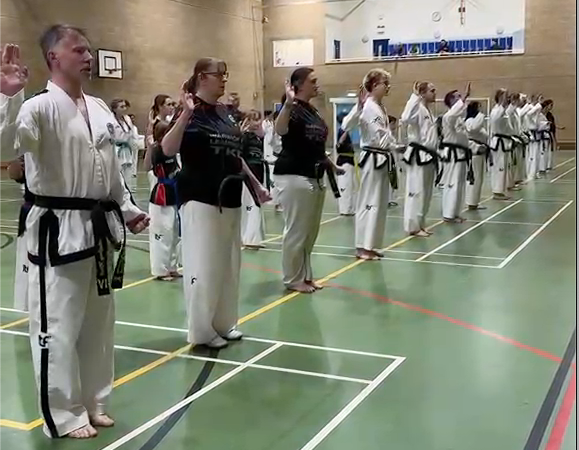
Why do we insist that students stand correctly in line at the beginning and end of a class? Because learning to follow a structure, remain attentive and behave appropriately is part of developing self-discipline. Standing in line teaches students to be patient, control unnecessary movement, concentrate and recognise that they are part of a group.
It also teaches an important lesson: we cannot always do exactly what we want, whenever we want. This is particularly important for our younger students, who are still developing the ability to manage distractions and impulses.
We ask parents to support us by encouraging their children to remain in line, listen to their instructor and resist the temptation to leave the class to seek reassurance or attention unnecessarily. If a child wanders over to a parent, gently directing them back to their instructor reinforces the lesson we are trying to teach. This is not about being unnecessarily strict. It is about helping children develop independence, confidence and an understanding of appropriate behaviour.
The same principle applies to adults. Arriving on time, being properly prepared, maintaining concentration and following instructions are all expressions of personal discipline.
Discipline is not about having someone constantly tell you what to do. True discipline is learning to do the right thing without needing to be reminded.
Courtesy, Communication and Personal Responsibility
Why do younger students have to raise their hand and ask permission before leaving the dojang, including when they need to use the toilet? Firstly, there is a practical reason. Instructors have a responsibility to know where their students are and to maintain a safe, organised training environment.
But there is also a wider lesson. We are teaching students to communicate clearly, courteously and confidently rather than simply walking away or expecting others to accommodate them without explanation. A student who learns to raise their hand, wait to be acknowledged and make a polite request is developing communication skills that will be useful at school, in future employment and throughout life.
Of course, genuine needs, particularly urgent toilet or medical needs, will always be treated sensibly. The objective is never to embarrass a student or deny them something necessary. The lesson is about communication, courtesy and taking responsibility for our actions.
Parents can help enormously by encouraging children to speak to their instructor rather than automatically leaving the class and approaching them. Small habits, repeated consistently, become natural behaviours.
Learning to Listen Is Learning to Succeed
One of the most important skills we teach has nothing to do with physical technique. It is the ability to listen. In a world of constant distractions, developing the ability to concentrate on an instruction, understand it and then act appropriately is increasingly valuable. When an instructor explains a technique, students must learn to pay attention rather than simply waiting for their opportunity to move. They must observe, process information and apply what they have been taught.
These are exactly the same skills required to succeed in education, professional training and employment. An individual who cannot listen effectively will struggle to learn, regardless of their natural ability. At WLTKD, we encourage students to ask questions when they do not understand something. However, we also expect them to make the effort to listen carefully in the first place.
Listening is not passive. It is an active skill that requires attention, respect and self-control.
Standards Are What We Do When Nobody Is Watching
Why do we expect students to wear their dobok correctly, tie their own belt, maintain their equipment and present themselves properly? Because attention to detail matters. A poorly tied belt might seem insignificant, but the attitude behind it is not. When a student takes responsibility for their appearance and equipment, they are learning to prepare properly, take pride in what they do and recognise that standards apply even to seemingly minor tasks. This is particularly important as students progress through the grades.
A black belt who cannot demonstrate the standards expected of a beginner is failing to set the example that their grade demands. And the same principle extends far beyond Taekwon-Do. The student who learns to prepare their dobok properly is developing habits that can influence how they prepare for an examination, a job interview, an important meeting or a professional responsibility. It is not the belt itself that matters most.
It is the mindset that says: if something is worth doing, it is worth doing properly.
Self-Control Is a Greater Strength Than Aggression
Martial arts training develops physical ability, but physical ability without self-control can become a liability. Students must learn to manage frustration, disappointment, excitement and sometimes fear. They will occasionally be corrected, challenged or asked to repeat something they believe they already know. They may lose a sparring contest, struggle with a pattern or find that another student progresses more quickly. How they respond to those situations is important.
We want students who can accept correction without taking offence, remain composed under pressure and respond thoughtfully rather than emotionally. These are qualities that become invaluable when dealing with disagreements, difficult colleagues, personal setbacks or confrontational situations. From my own experience in security and close protection, I know that the ability to remain calm, assess a situation and exercise sound judgement is often far more important than physical capability.
Real confidence is not about proving how tough you are. It is about having the self-control to respond appropriately, particularly when under pressure.
Humility, Teamwork and Looking After Others
Taekwon-Do is an individual journey, but nobody progresses entirely alone. Every student benefits from the knowledge, encouragement and support of others. At WLTKD, our senior grades and black belts are expected to recognise that their responsibilities extend beyond their own training.
They should set an example, support less experienced students, help maintain standards and contribute positively to the club. Teaching and mentoring others is also an important part of their own development. Being technically capable does not automatically make someone a good leader. Leadership requires patience, communication, empathy, consistency and a willingness to help others succeed.
Our younger students learn by watching how senior members behave. When they see experienced black belts taking the time to help beginners, they learn that achievement should bring greater responsibility, not a sense of superiority. There will always be someone more experienced, more capable or further along their journey. Recognising that is not a weakness. It is humility.
The strongest clubs, like the strongest teams in life, are built by people who understand that individual success and collective responsibility go hand in hand.
Perseverance: Learning Not to Give Up
Progress in Taekwon-Do is rarely straightforward. Some techniques take weeks to learn and years to refine. Gradings require preparation. Competitions test confidence and composure. There will be setbacks, disappointments and occasions when progress seems frustratingly slow. That is precisely why the training is valuable.
We are teaching students that improvement requires consistent effort, that mistakes are part of learning and that temporary failure does not define their ability. A student who struggles with a pattern but continues practising is developing something far more valuable than simply remembering a sequence of movements. They are learning perseverance. And perseverance becomes important when facing examinations, career challenges, difficult personal circumstances and the many obstacles life inevitably presents.
We do not want students who believe everything should be easy. We want students who understand that worthwhile achievements often require sustained effort.
When something becomes difficult, the answer is not automatically to give up. It is to assess, adapt, learn and keep moving forward.
High Standards Must Begin With the Instructors
There is one final point that I believe is particularly important. As instructors, we cannot reasonably expect students to demonstrate standards that we are unwilling to uphold ourselves. Leadership by example is fundamental to the way I want Warwick & Leamington TKD to operate.
Our instructors must demonstrate professionalism, preparation, patience, technical competence and a genuine commitment to their own continued development. They must be willing to accept feedback, improve their knowledge and recognise that achieving a senior grade does not mean they have finished learning. Standards must be consistent and fair, not dependent on an instructor's mood or personal preferences. And discipline should never be confused with intimidation or humiliation.
We can maintain a demanding training environment while remaining encouraging, approachable and supportive. Indeed, I believe that combination is essential.
High expectations and genuine support are not opposites. Together, they create the environment in which people can achieve more than they initially thought possible.
We Are Developing People, Not Just Martial Artists
At Warwick & Leamington TKD, our aim is not simply to produce students who can perform impressive techniques or pass their next grading. Of course, technical excellence matters. We take our Taekwon-Do seriously, and we expect students to work towards the highest standard they are capable of achieving.
But there is a much bigger picture. We want children who grow into respectful, confident and resilient young adults. We want teenagers who develop self-belief, personal responsibility and the courage to face challenges. We want adults who improve their fitness and martial arts ability while strengthening their confidence, focus and determination. And we want senior students who understand that true achievement brings with it a responsibility to help others.
That is why we insist on the small things.
Why we bow.
Why we stand in line.
Why we listen.
Why we tie our belts properly.
Why we show courtesy, accept correction and support our fellow students.
Because these behaviours are not simply traditions to be followed inside the dojang. They are habits that shape character.
The real measure of our success as instructors is not simply what our students achieve while wearing a dobok. It is the qualities they carry with them when they take it off.
And perhaps most importantly, they learn that respect, discipline and self-control aren't things you switch on when you walk into the dojang. They're qualities you carry with you into school, friendships, family life and adulthood. At our Academy we try to instil these values and our parents pointing these out to the kids and the whys and purpose behind this certainly does help.